Hot-Tire Pickup: Why Texas Heat Ruins Cheap Garage Floors
Hot-tire pickup explained for Conroe, TX garages: why 100-degree Texas heat lifts cheap coatings and how the right system prevents it.
- hot tire pickup
- garage floor coating
- conroe tx
What hot-tire pickup actually is
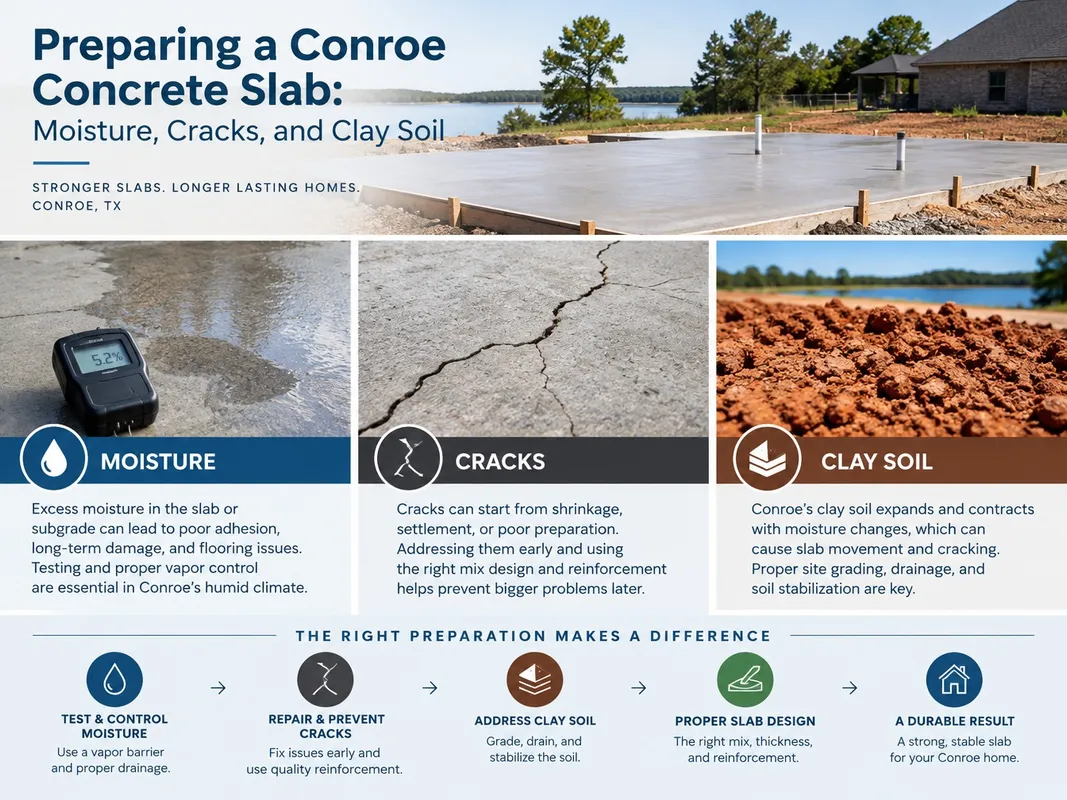
Hot-tire pickup is when a warm tire bonds to a floor coating and lifts a patch of it off the concrete, leaving a tread-shaped scar. It is not dirt, and it is not the tire melting. It is the coating softening, sticking to the rubber, and tearing away from the slab when the car pulls out. You see it most on cheap epoxy, single-part garage paint, and coatings applied over a slab that was never properly prepared. A correctly built system with a polyaspartic topcoat and diamond-ground concrete does not do this.
Why Texas heat triggers it
On a 100-degree afternoon in Conroe, the air is not the problem. The pavement is. Dark driveway and apron concrete can run well above air temperature after hours of direct sun, and a tire that has been sitting on that surface soaks up the heat. Add the heat a tire generates from the road, and the rubber that contacts the floor can be far hotter than the ambient temperature you see on a dashboard thermometer. Park that hot tire on a coating that softens at a modest temperature, let it cool and stick, then drive off, and the coating comes with it.
This is a summer problem in Southeast Texas for the simple reason that our summers are long. The window where a cheap floor behaves is short.
The physics, in plain terms
Every coating has a temperature at which it starts to move from a hard solid toward a softer, rubbery state. Push it past that point, and it stops acting like a floor. Cheap epoxy and single-component garage paint have low softening temperatures, which is why they are the products that fail. Polyaspartic topcoats have a much higher tolerance for heat, so the same tire that would scar a budget floor does nothing to a properly built one.
The takeaway is simple: hot-tire pickup is a property of the coating, not of your tires.
The worst spot is right inside the garage door
Pickup almost always shows up first in the strip just inside the garage door, and under the two or four spots where the car regularly parks. The door strip gets the sun when the garage is open and holds heat against the floor. The parking spots get the same tires, at the same temperature, day after day. Together they are where the film is stressed the hardest, which is why we often add a second topcoat there. Look at those areas first if you suspect a problem on an older floor.
Why cure time and install conditions matter
A surprisingly common cause of early failure is a car parked on a floor that has not finished curing. Coating chemistry keeps hardening after the floor is dry to the touch, and the first days are when the film is most vulnerable. If a hot tire lands on it during that window, the damage can set in before the floor reaches its full strength. Hot, humid install days also stretch cure times, so the safe wait before parking can be longer here than the label suggests.
It is almost never the tire’s fault
We hear it every summer. “My tires ruined my floor.” They did not. Tires do what tires do, and every car on the road has them. If your tires could destroy a floor, every commercial garage and dealership in Texas would have destroyed floors, and they do not.
What happened is that the coating was not built to take heat. Softening and peeling under a hot tire is a failure of the film, and the fix is a floor built for the conditions, not a different set of tires.
The three real causes
Nearly every case we inspect comes down to one or more of these.
The wrong resin. Single-part epoxy paint or a low-grade two-part product does not have the heat resistance a garage needs. It looks fine until the first hot day.
Poor surface preparation. If the slab was acid-etched, sealed, or simply cleaned instead of mechanically ground, the coating has no real mechanical bond. Even a good resin can peel when the bottom of it is only sitting on the surface.
No UV- and heat-stable topcoat. A colored base coat left bare, or sealed with a cheap clear, has nothing protecting it from sun, heat, and chemicals. A polyaspartic topcoat is the layer that handles all three.
Why grinding, not etching, is the difference
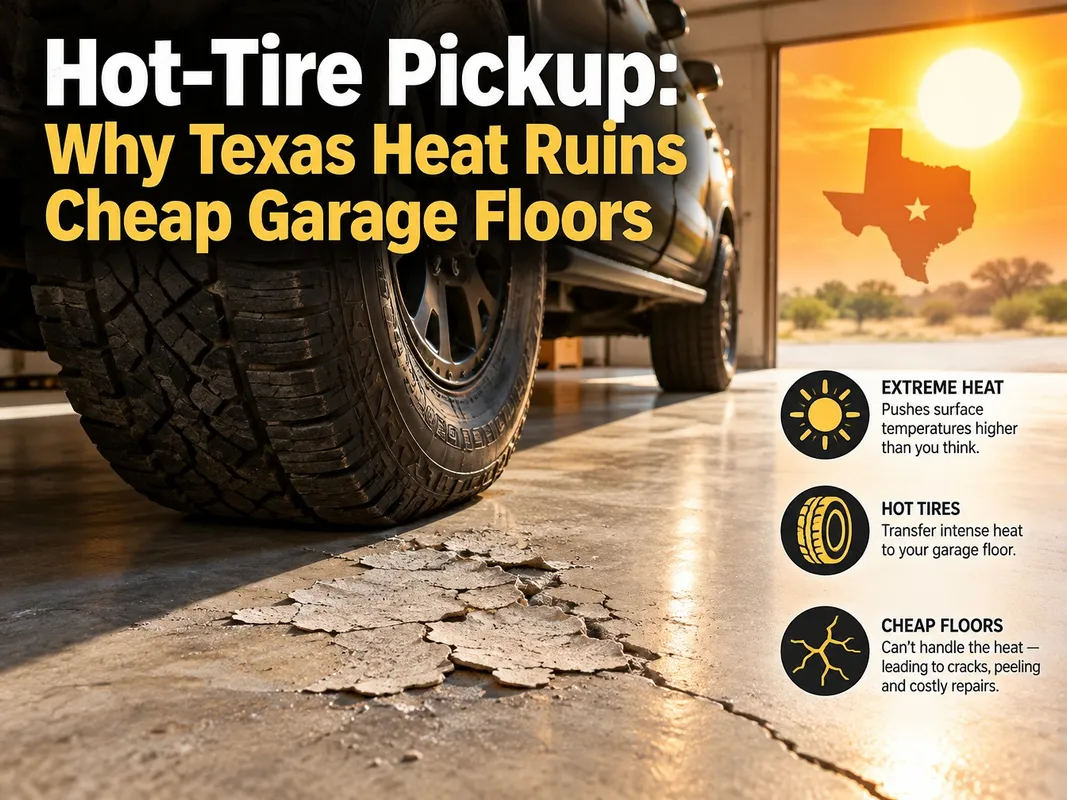
The bond between coating and concrete is mechanical, not magnetic. Diamond grinding opens the pores and creates a surface profile that the resin can grip. Acid etching cleans the surface and roughens it slightly, but it does not create the same profile, and it can leave residue that actually weakens the bond. When a floor peels in sheets under a tire, a lack of grinding is usually the reason. We cover the whole process on our concrete prep and repair page.
What a floor that resists pickup looks like
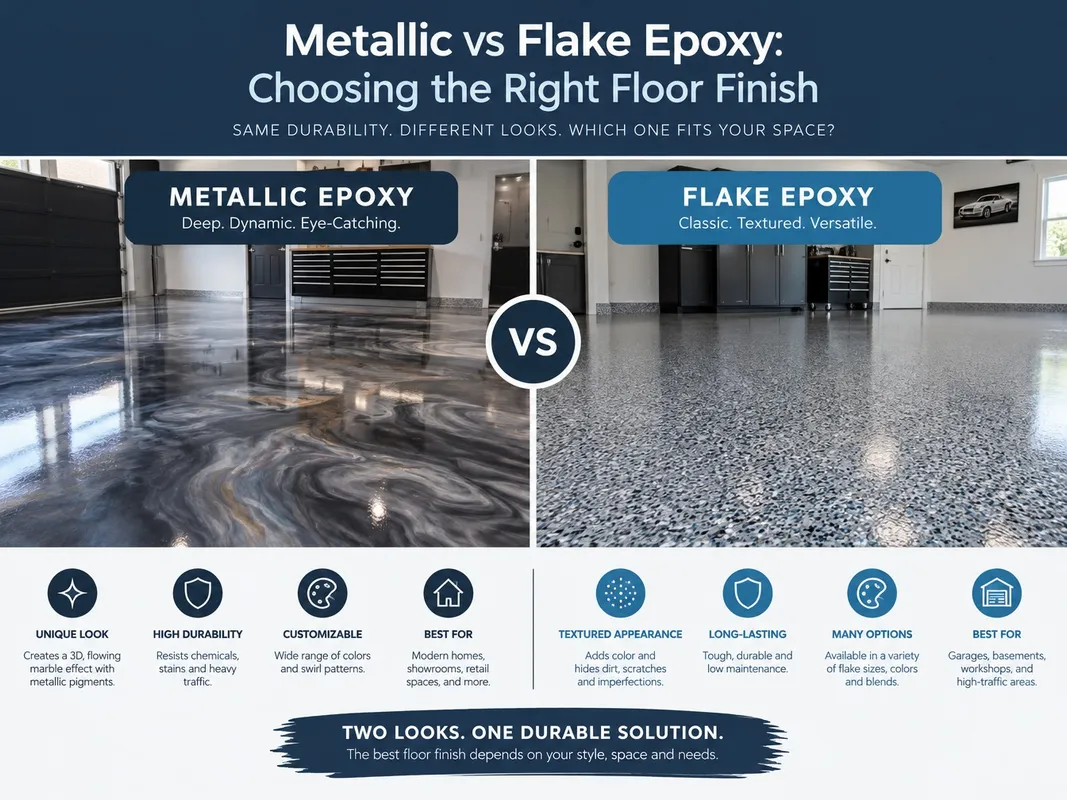
The system that prevents hot-tire pickup is the same one that prevents most other garage-floor failures: a diamond-ground slab, a penetrating or moisture-mitigating primer where needed, a pigmented epoxy base coat, a full broadcast of vinyl flake, and a UV-stable polyaspartic topcoat. The topcoat is the part that takes the heat and the sun. You can see the components on our garage floor coatings and polyaspartic flooring pages.
For a garage door that faces the afternoon sun, we will often add a second topcoat in the sun-exposed strip and under the regular parking spots. It is a small cost for the area that takes the worst of it.
Warning signs before total failure
Pickup rarely appears out of nowhere. Look for dull patches where the car normally sits, a slight lift or curl at the edges of the coating, or faint tread marks that do not wash off. Those are early warnings that the film is softening and losing its grip. If you catch it early, a repair is far cheaper than a full regrind.
Can you repair a floor that already has pickup?
Usually, yes. The failed coating has to come off, which means grinding back to bare concrete in the affected area or across the whole floor if the film is compromised everywhere. Then we rebuild the system with proper prep and a heat-tolerant topcoat. A localized repair can blend into a flake floor reasonably well; a solid-color floor is harder to match exactly, because the new patch and the old floor age at slightly different rates. We will tell you honestly whether a spot repair makes sense or whether the floor is better off redone.
What we do differently
Before we quote, we test the slab for moisture and inspect the existing surface. On the install, we grind the concrete, repair cracks and joints, prime where the slab needs it, lay the epoxy base, broadcast flake to refusal, scrape and vacuum, then apply the topcoat. We also tell you how long to wait before parking. Curing is part of the job: a floor that gets a hot car parked on it before it has fully cured can fail for that reason alone, no matter how good the product is.
Why store-bought DIY kits fail here
Big-box epoxy kits can work in a climate-controlled shop, but they are a poor fit for a Conroe garage. They usually rely on acid etching rather than grinding because most homeowners do not own a diamond grinder, the film is thin, and the clear coat that comes in the box is not a polyaspartic topcoat built for heat and UV. The kit is not defective; it is simply not engineered for a 100-degree slab with hot tires on it. The labor of doing it yourself is real, and doing it twice is worse than paying to have it done once.
Commercial garages feel it too
If hot tires peel a home garage, they do a lot more damage in a shop, dealership, or fleet facility where cars come and go all day. That is why commercial and industrial flooring is specified with heavier builds and higher-temperature products. The same principle applies at home, just at a smaller scale.
Getting a floor that can take a Conroe summer
The cure for hot-tire pickup is not a special additive or a gimmick. It is the right resin over a properly prepared slab. That is the whole job, and it is the only version of it worth paying for. If you want to understand how the systems compare first, read epoxy vs. polyaspartic flooring, and if you are budgeting, our cost breakdown for Conroe will help you plan.
Ready to stop worrying about summer? Request a free estimate or call Conroe Epoxy at (346) 220-3416, and we will take a look at your garage.