Commercial and industrial flooring built for real workloads
A commercial floor is judged by what it has to survive. Service bays take hot tires, dropped tools, and chemical spills. Warehouses take forklift traffic and constant abrasion. Retail and restaurant floors take foot traffic, cleaners, and the expectation that they still look presentable. The right coating is the one spec’d for those specific loads, not a generic garage finish applied at scale.
We install epoxy, polyaspartic, and flake systems across Conroe and Montgomery County for shops, warehouses, storefronts, and light industrial spaces. The system changes with the job. The prep discipline does not.
Why commercial floors fail in this climate
Commercial failures usually trace back to one of a few causes: insufficient surface prep, moisture in the slab, the wrong topcoat for the chemicals on the floor, or hot tires lifting a weak clear. All of those are magnified in our climate. Gulf humidity and clay soil push moisture and movement into slab-on-grade concrete, and Texas heat raises surface temperatures under equipment and tires.
We address that up front with moisture testing, diamond grinding to open the concrete profile, and repair of cracks, joints, and spalled areas. For heavy service areas we spec a polyaspartic topcoat, which resists hot-tire pickup and chemicals better than a plain epoxy clear. Getting the prep and the wear layer right is what separates a floor that lasts from one that peels in a year.
Commercial spaces also tend to have constraints a garage does not. There are drains and floor sinks to keep clear, equipment that cannot move, and doorways and dock edges that take constant abuse. Those details shape the plan as much as the coating itself. We note them during the site walk and build them into the schedule, so the crew is not improvising around a lift or a reach-in cooler on install day.
Our commercial install process
Large or small, every project follows the same controlled sequence:
- Site walk and scope. We measure, review how the space is used, check drains and slopes, and test for moisture.
- Written proposal. You get a system spec, a square-foot price, and a schedule that accounts for your operating hours.
- Scheduling and phasing. We plan the work in sections or off-hours so the business keeps moving.
- Surface preparation. Diamond grinding or shot blasting, plus edge work around equipment and walls.
- Repair and moisture control. Cracks, joints, and spalls are filled; moisture-mitigation primer is applied where testing calls for it.
- Base and build coats. The epoxy or flake base is installed to the specified build.
- Topcoat and marking. A clear or pigmented topcoat goes down, with slip-resistant aggregate and line marking where needed.
Options and finishes
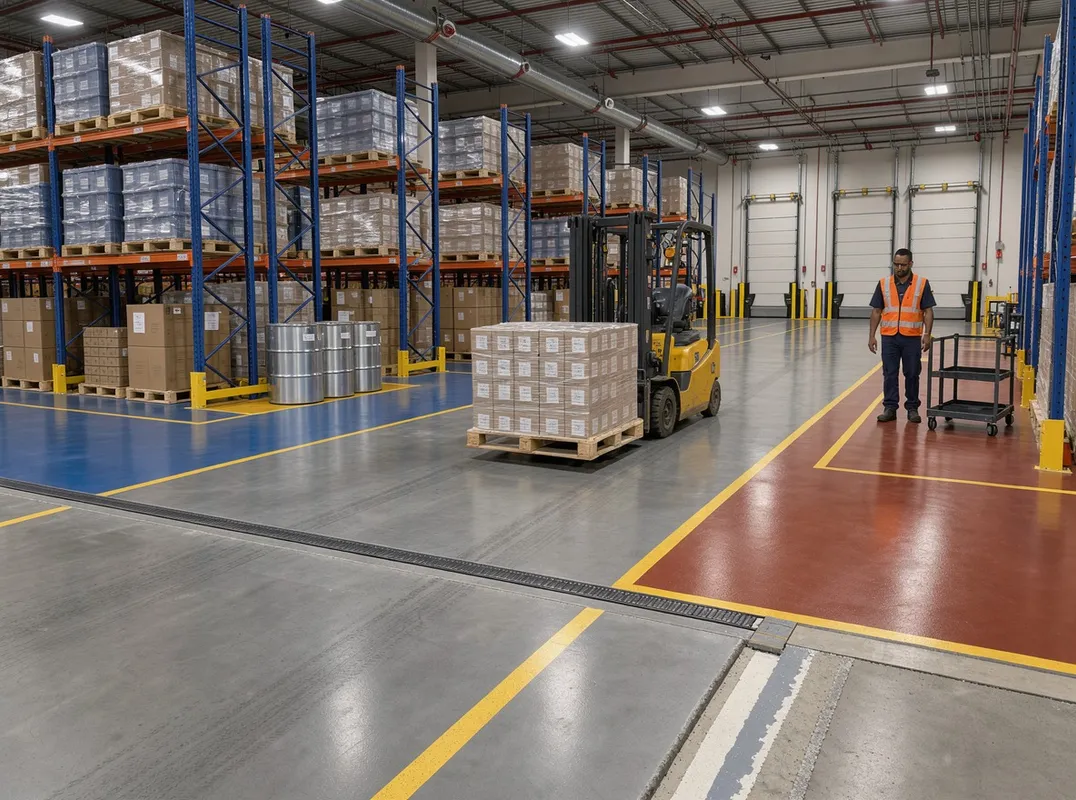
Commercial systems range from straightforward solid-color epoxy to full-broadcast flake and high-build polyaspartic. Color choice often does real work: light greys brighten a dim warehouse, while safety colors and contrasting stripes designate walkways, forklift lanes, and hazard zones. We can add aggregate for wet or greasy areas and match a sheen to the space, from a high-gloss showroom floor to a more muted service-bay finish.
For warehouse and industrial spaces, we also consider racking, forklift traffic, and how the floor will be cleaned. A floor that gets scrubbed by a rider or crossed by steel wheels is spec’d differently than one that only sees foot traffic. Getting the abrasion resistance right up front avoids a repaint in a couple of years.
What commercial flooring costs in Conroe
Commercial coatings are priced by the square foot, and most projects fall between $2.00 and $5.50 per square foot. The system build, slab condition, prep method, moisture control, and line marking all factor in. Large, open floors cost less per square foot than small, cut-up spaces with lots of equipment to work around. We provide a written, itemized proposal after a site walk.
On phased projects we price the work in stages too, so you can see the cost of each section and schedule it around your busy season. If budget is tight, we can prioritize the highest-wear areas first and complete the rest in a later phase.
Related services
- Need a fast-curing wear layer? See polyaspartic flooring.
- Want a durable, textured floor? Look at flake epoxy systems.
- A custom look for a showroom or lobby? Read about metallic epoxy flooring.
- Slab cracked or damp? Start with concrete prep and crack repair.
Ready to scope the job? Request a free estimate or call us at (346) 220-3416.