How Much Does Epoxy Flooring Cost in Conroe, TX?
What epoxy flooring costs in Conroe, TX: real per-square-foot ranges, what moves the price, and why cheap quotes fail. Free on-site estimate.
- epoxy flooring cost
- epoxy flooring conroe
- garage floor cost
What epoxy flooring costs in Conroe, in short
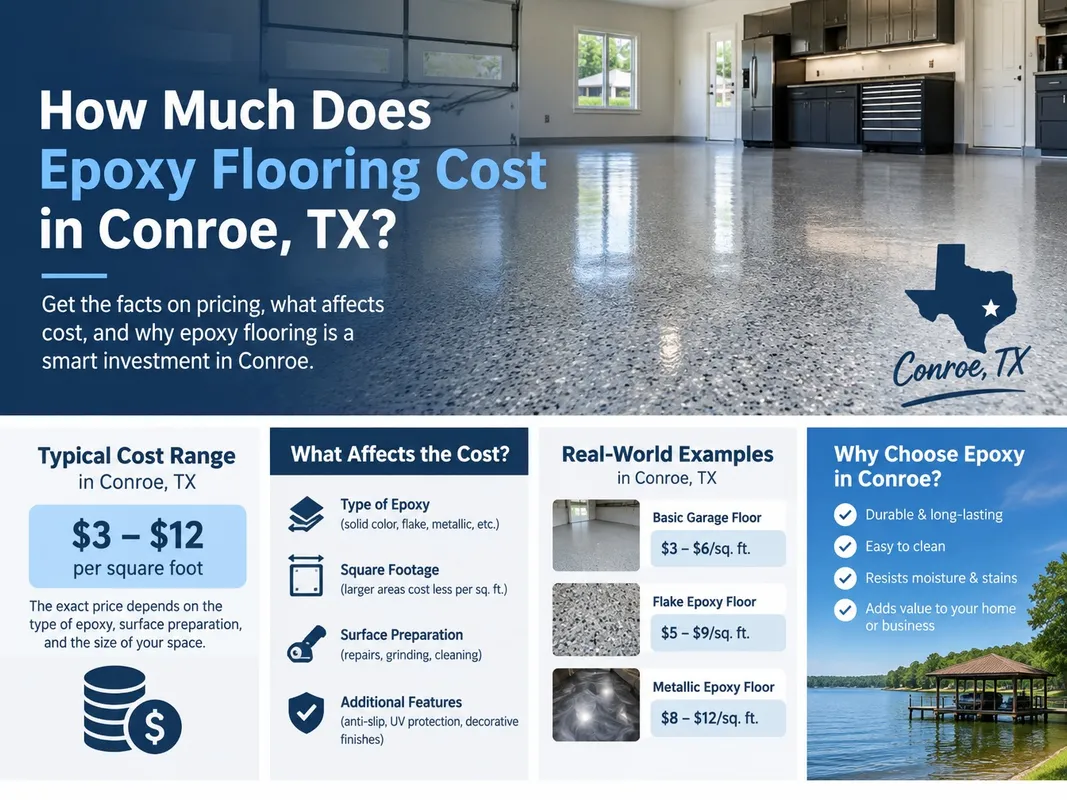
Most residential epoxy garage floors in Conroe land between $4 and $9 per square foot installed, which puts a typical two-car garage at roughly $1,600 to $3,400. A basic single-color epoxy floor sits at the low end. A hybrid epoxy-and-polyaspartic system with a full flake broadcast and UV-stable topcoat sits in the middle to upper range. Three-car garages, heavy crack repair, and slabs that need moisture mitigation run higher. These are planning ranges, not quotes. The only accurate number comes from looking at your slab.
Why we price per square foot, not per garage
Homeowners often ask for “a price on a two-car garage.” The problem is that a two-car garage is not a fixed size. A compact two-car can be under 400 square feet. A deep two-car with storage along the wall can push past 550. That difference is a whole day of material and labor, and it changes the number.
We measure the actual square footage and price from there. Once we know the area, the rest of the quote is built from what your slab needs underneath the coating, not from a flat rate.
Square footage also has a bigger effect than people expect because of the fixed costs at the edges. Setup, equipment, and perimeter work do not shrink on a smaller floor, so a compact garage can carry a higher per-square-foot price than a large one while costing less in total. That is why comparing two estimates by their per-square-foot number alone can be misleading.
Typical installed ranges by project type
The table below is a general planning guide for Conroe-area homes. It is not a quote, and it assumes normal access and a slab that is not severely damaged.
| Project | Typical size | Planning range installed | What drives the number |
|---|---|---|---|
| Basic epoxy garage floor | 400–500 sq ft | $1,800–$2,800 | Single color, thin clear, minimal repair |
| Flake epoxy garage floor | 400–500 sq ft | $2,400–$3,400 | Full flake broadcast, UV clear topcoat |
| Epoxy + polyaspartic hybrid | 400–500 sq ft | $2,800–$4,000 | Polyaspartic topcoat for heat and UV |
| Premium full-flake system | 400–600 sq ft | $3,400–$5,000 | Extra topcoat, moisture primer, heavy prep |
| Commercial / industrial | 1,000 sq ft and up | Often $3–$7 per sq ft | Build thickness, traffic, line striping |
The overlap between rows is real. A clean 600-square-foot garage with a basic system can land in the same range as a rough 400-square-foot garage with a premium one. Condition and system matter as much as size.
What moves the price up or down
Every quote we write comes down to a handful of variables.
Square footage. Coating is priced by area, and per-square-foot cost drops as the floor gets larger because setup, mobilization, and edge work spread across more square feet.
Slab condition. A smooth, sound slab needs only grinding and a coating. Cracks, spalling, and a rough finish add prep time and material.
Crack and joint repair. Hairline cracks are quick to fill. Wide or moving cracks take more work, and control joints need to be handled deliberately so they do not telegraph through the finish.
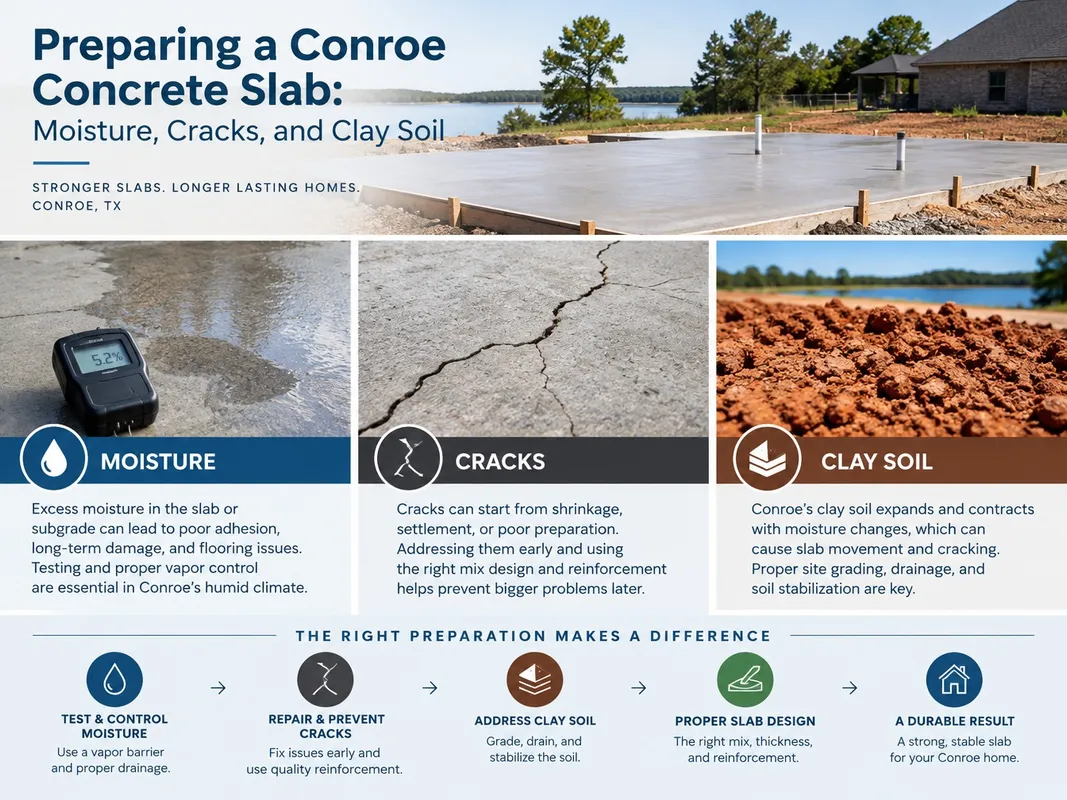
Moisture mitigation. Slab-on-grade garages in Montgomery County frequently test high for moisture. A moisture-mitigating primer is an added line item, but skipping it is how coatings blister later.
Previous coatings. Old paint, sealer, or failed epoxy has to be removed, usually by grinding, before anything new goes down.
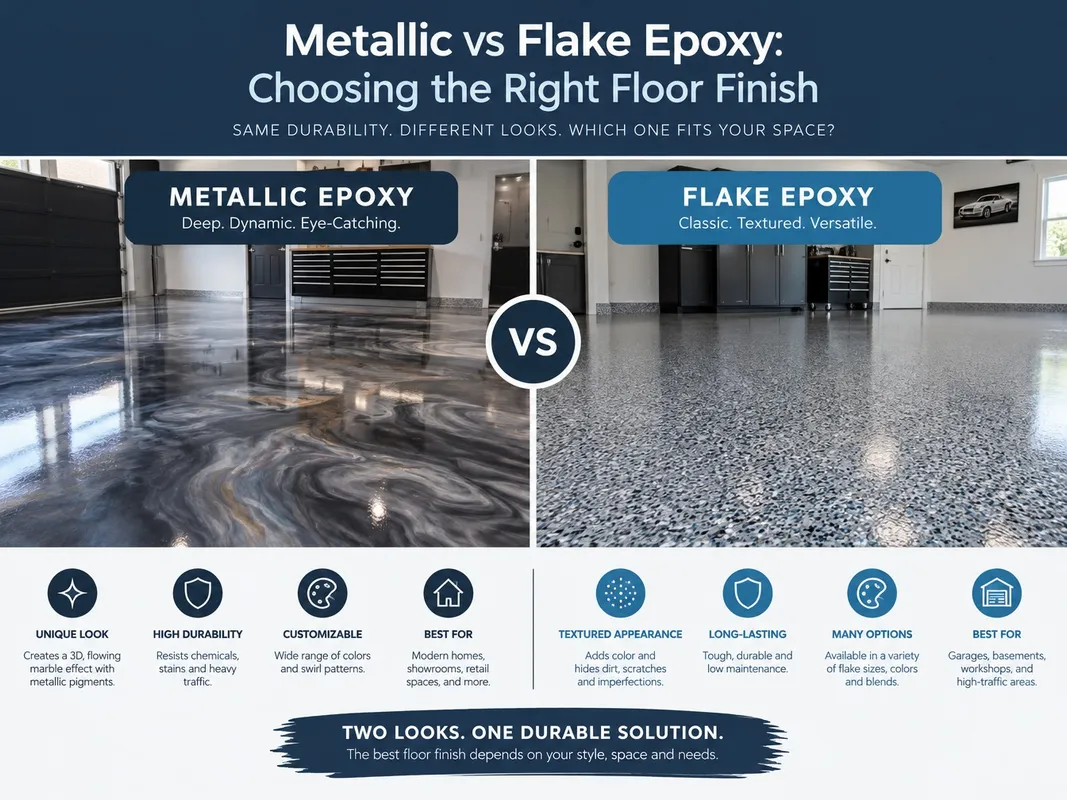
Flake coverage and type. A light flake sprinkle and a full broadcast are different products at different costs. Flake is sold by the pound and coverage adds up fast.
Number of topcoats. One clear topcoat is standard. A second topcoat at the garage door and under parking spots adds durability at a modest cost.
Edges, steps, and curbs. Stem walls, steps, and uneven perimeters take hand work that a flat floor does not.
The line items cheap quotes leave out
When you see a quote at two dollars per square foot, it usually means most of the real work is missing. That price typically assumes no moisture testing, no crack repair, no primer, an acid etch instead of grinding, a single thin topcoat, and a product meant for light duty.
It is not that those crews are dishonest. It is that a cheap floor is built to a different standard, and once you account for the prep and the topcoat you actually need, the price climbs toward the realistic range anyway. The difference is that on the cheap path, you often pay twice: once for the floor that fails, and again to have it ground off and redone.
What a complete quote includes
When we write a quote, it lists the parts of the job rather than a single lump number. A complete epoxy floor quote should account for:
- On-site measurement and a moisture test.
- Removal of any old coating or sealer.
- Diamond grinding of the full slab and the edges.
- Crack, joint, and spall repair.
- A primer, where the slab calls for one.
- The base coat, color, and flake broadcast.
- The number and type of topcoats.
- A clear return-to-service time before you park on it.
If a quote cannot tell you which of those are included, that is the first question to ask before you compare the totals.
Why cheap epoxy fails specifically in Conroe
Southeast Texas is hard on coatings. Summer air temperatures near 100 degrees push unshaded concrete surfaces well above that, and tires that just came off that hot pavement can soften a low-grade film. Gulf humidity works against slow-curing products, and older slabs without a vapor barrier push moisture from below. A thin, budget epoxy over an acid-etched slab has no margin for any of it. The result is peeling, blistering, and the tire-shaped patches known as hot-tire pickup.
Prep and repair are not padding
Diamond grinding, crack filling, and moisture testing are the parts of the job you will never see, and they are the parts that decide whether the floor lasts. We grind the slab to open its surface profile, fill and bridge cracks, and prime where the slab calls for it. You can read the details on our concrete prep and repair page. When a quote is much lower than the others, compare what each bidder plans to do in this step; that is usually where the gap lives.
Does the coating system change the price?
Yes, and it should. A straight epoxy flake floor is the most affordable option. Adding a polyaspartic topcoat raises material cost but buys UV stability and hot-tire resistance that matter in a Texas garage. We break the tradeoffs down in epoxy vs. polyaspartic flooring, and the systems themselves are described on our polyaspartic flooring and garage floor coatings pages.
Value over the life of the floor
The number that matters is not only the day-one price. A correctly prepped, properly topped floor should stay serviceable for many years of daily parking, while a cheap floor that blisters or peels in the first few summers costs you the original price plus the grinding and re-coating to fix it. When you spread the cost of a good floor across its life, the gap between the cheap quote and the honest one narrows considerably. Bare concrete has its own costs too: dusting, staining, and the steady damage that comes with spilled oil and road salt sitting on an unprotected surface.
Commercial, shop, and warehouse floors
Garages are our most common residential job, but the same pricing logic applies to larger spaces. Commercial and industrial floors are usually quoted by the square foot with volume breaks, and the number depends on the build thickness, the traffic the floor will see, and whether you need line striping or a chemical-resistant system. See commercial and industrial flooring for how those projects are scoped.
How to compare two quotes fairly
Put the written quotes side by side and check that each one includes moisture testing, mechanical grinding, crack and joint repair, a primer where needed, the flake coverage you expect, and a defined number of topcoats. Ask what product is being used, and how many coats. A quote that lists the prep and the topcoat is not more expensive than a cheap one; it is just showing you the work the cheap one left out.
Getting an accurate number for your floor
We do not price a floor from a photograph or a phone description, because the slab is half the job. An on-site estimate takes about twenty minutes: we measure, check for cracks and moisture, and talk through the system that fits how you use the space. You get a written, itemized number you can compare, with no pressure and no obligation. Learn more about our process if you want to know what to expect.
Ready for your number? Request a free estimate or call Conroe Epoxy at (346) 220-3416, and we will get you on the schedule.