
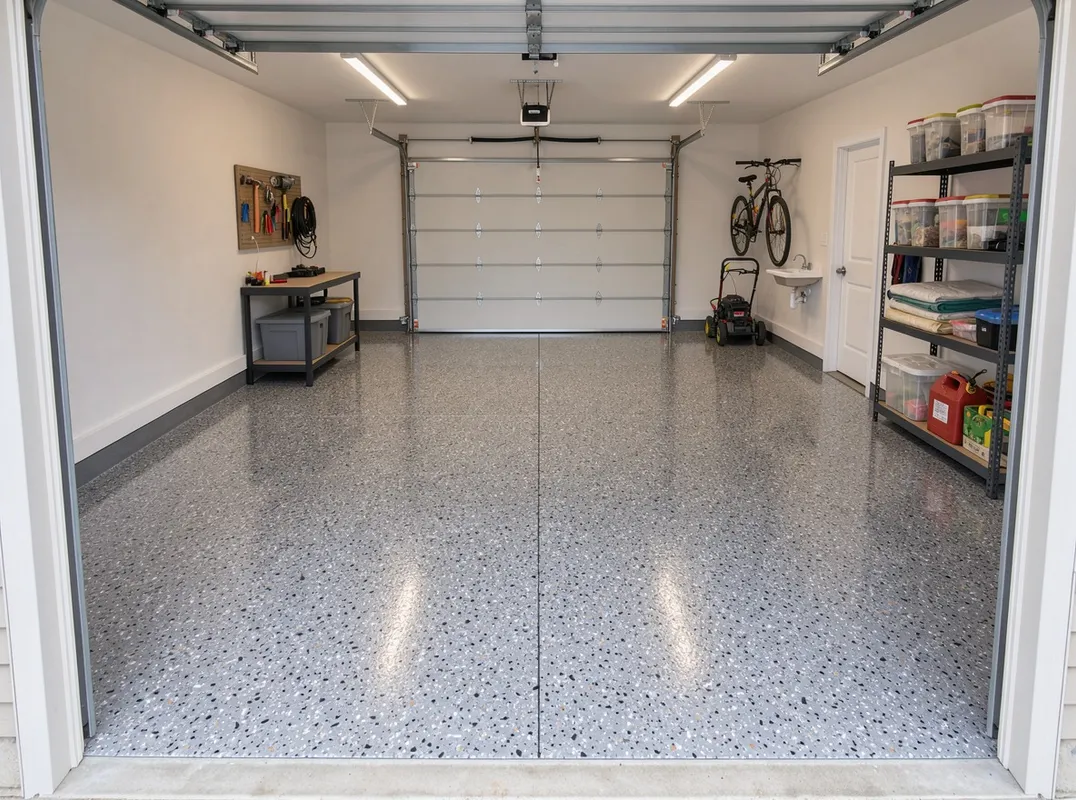
A garage floor that survives a Conroe summer
A bare concrete garage floor in Conroe does not stay clean for long. Between Gulf-Coast humidity, red clay tracked in off the driveway, and tires that come off 140-degree pavement, uncoated slabs stain, dust, and spall within a few years. A properly installed garage floor coating gives you a surface you can sweep, hose down, and actually use.
This is the system we install for most homes in Conroe and across Montgomery County: diamond-ground concrete, a penetrating epoxy primer, a full-broadcast decorative flake base, and a UV-stable polyaspartic topcoat.
Why full-flake beats a single-color epoxy floor
A solid-color epoxy garage floor looks sharp on day one, but it shows every scuff, tire mark, and drop of oil. A full-broadcast flake system covers the slab with vinyl flakes until the floor will not accept any more, then locks them under a clear topcoat. The result is a floor that hides dust, resists slips when wet, and still looks clean after years of real use.
Flake also adds texture. In a garage, texture is function — it gives you grip underfoot and helps hide the small imperfections every concrete slab has.
Our garage floor coating process
Every project follows the same steps so the result holds up:
- On-site evaluation. We measure the garage, check for cracks, spalling, and previous coatings, and test the slab for moisture.
- Surface preparation. We grind the entire floor with diamond tooling and edge-grind up to the walls. This is the step that separates a coating that lasts from one that peels.
- Repair. Cracks and control joints are filled. Larger voids are patched and feathered level.
- Priming and base coat. A primer goes down first where the slab needs it, followed by the colored epoxy base coat.
- Flake broadcast. Vinyl flakes are broadcast to refusal across the wet base coat.
- Topcoat. After scraping and vacuuming the excess flake, we apply a polyaspartic topcoat that seals the flake and resists UV, chemicals, and hot tires.
What it costs in Conroe
Garage floor pricing depends on square footage, the condition of your concrete, and the system you pick. As a working range, most two-car garages fall between $1,600 and $3,400. Three-car garages, heavy crack repair, and moisture-control primers sit at the higher end of that range.
We do not quote coatings over the phone from a photo. An on-site estimate takes about twenty minutes and gives you a written number you can compare.
Choosing a flake blend and topcoat
Flake systems come in dozens of color blends, from tans and greys that read as clean concrete to high-contrast black-and-white mixes that give the floor some personality. We bring samples so you can see them in your own garage light rather than on a phone screen. A few things worth deciding:
- Blend density. A full broadcast covers the base coat completely, which is the most durable and the most forgiving of slab imperfections. A lighter “partial broadcast” leaves more of the base color showing and costs a little less, but it shows dust and flaws more readily.
- Topcoat sheen. Gloss reflects light and looks sharp; matte and satin hide scuffs better and read as less slippery-looking. We can add an anti-slip aggregate to either one.
- Edge detail. We cut the coating flush to the stem walls and control joints rather than letting it puddle unevenly. Clean edges are most of what makes a garage floor look professional.
Keeping the floor clean after install
A coated garage floor is easy to live with. Sweep or blow it out for dust and grit, and damp-mop with a mild cleaner when it needs more. Avoid abrasive pads, wire brushes, and aggressive degreasers, which dull the topcoat over time. Most spills — oil, coolant, paint drips — wipe up without staining because the finish is non-porous. If the clear topcoat eventually shows wear in high-traffic areas after years of use, it can be refreshed without tearing out the flake base, which is one reason we build these floors with a serviceable top layer.
What we need from you before install
The garage needs to be empty so we can grind the entire slab and coat the edges. Vehicles, shelving, and stored items come out before we arrive, and the concrete should be as dry as the weather allows. Install usually takes one to two days: grinding and base coat with flake broadcast on day one, then scraping, vacuuming, and the polyaspartic topcoat on day two. Keep vehicles off the floor for about 24 hours after the final coat and avoid parking hot tires on it for the first week while the film finishes curing. We give you a specific timeline when we finish the job.
Related services
- Choosing a faster schedule? See our polyaspartic flooring options.
- Want a one-of-a-kind look for your garage or shop? Look at metallic epoxy flooring.
- Coating a shop, warehouse, or storefront? Read about commercial and industrial flooring.
- Slab cracked or holding moisture? Start with concrete prep and crack repair.
Ready for a number? Request a free estimate or call us at (346) 220-3416.