
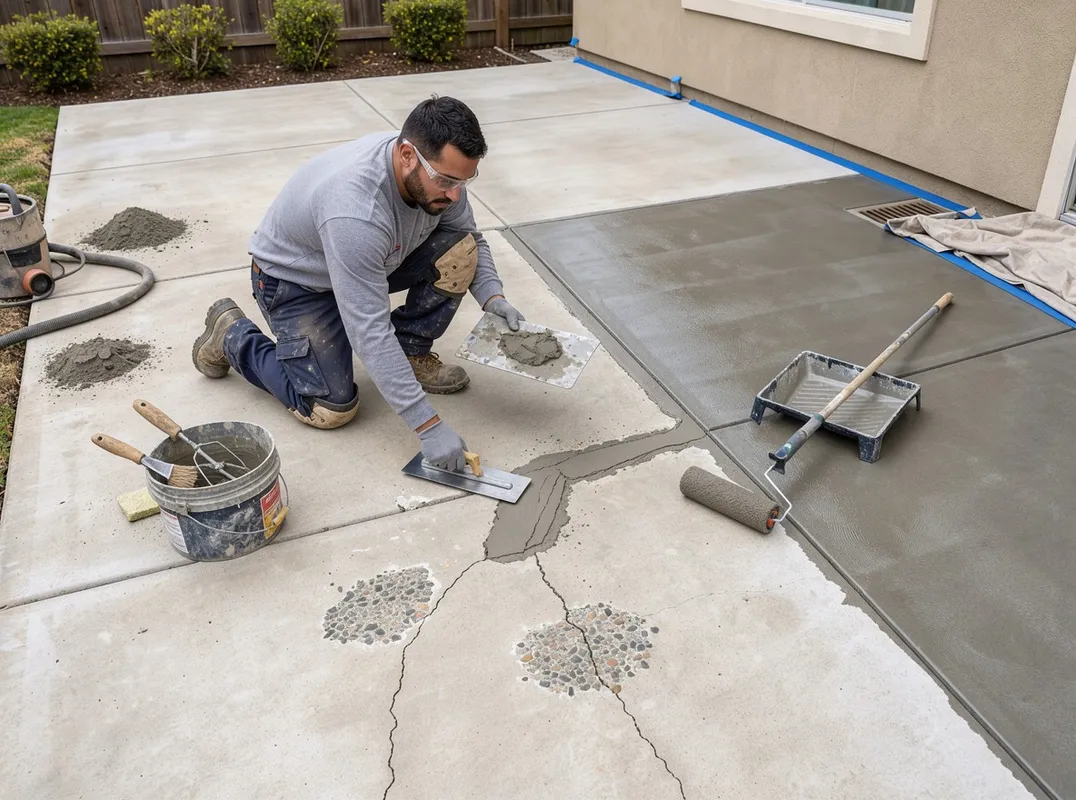
Concrete prep and crack repair: the part that decides everything
Every coating failure we get called to look at traces back to prep. A floor that peeled in sheets was usually applied over a smooth, sealed, or damp slab. One that blistered trapped moisture under an incompatible primer. One that cracked along an old joint never had that joint repaired. The coating is the visible part, but the prep underneath is what makes it last.
Concrete prep and crack repair is the work we do before any finish goes down, whether it is flake, polyaspartic, metallic, or a commercial build. It is not glamorous, and it is the reason our floors hold up.
Why slab prep matters in Conroe and Montgomery County
Concrete here is poured on black clay that swells when wet and shrinks when dry. That movement opens cracks and works control joints year after year. Slab-on-grade concrete also wicks moisture from our humid Gulf air and from the soil underneath. Those two facts, movement and moisture, are behind most of the floor failures in this area.
On top of that, many Conroe slabs were sealed, painted, or previously coated. Those layers have to go before a new coating can bond. Add hot tires and summer UV, and a coating applied over a weak surface does not stand a chance.
Contamination is the other hidden problem. Concrete absorbs oil, grease, and even the residue of old cleaners, and some of that does not come up with a broom or a pressure washer. Grinding removes the top layer where those contaminants sit, which is another reason we grind rather than just clean and coat. A slab that has held a leaking car or a grease trap needs extra attention at this step.
Our prep and repair process
Preparation is a sequence, and each step builds on the last:
- Evaluation. We inspect the slab for cracks, spalling, existing coatings, and contamination, and we test for moisture.
- Coating removal. Failing paint, epoxy, or sealer is stripped or ground back to bare concrete.
- Diamond grinding. The full slab is ground to open its surface profile and edge-ground up to walls, posts, and thresholds.
- Crack and joint repair. Cracks are cleaned and filled; control joints are prepped and filled or left as designed, depending on the system.
- Spall and void patching. Cratered and low areas are patched with a repair mortar and feathered level.
- Moisture mitigation. Where testing calls for it, a moisture-blocking primer is applied before any coating.
- Final clean and inspection. The slab is vacuumed and checked before the coating crew takes over. Prep and coating often run back to back in one schedule.
Why this step is not optional
It is tempting to treat prep as overhead, especially when a slab looks flat and clean. But the bond between coating and concrete depends entirely on the surface it is bonding to. Grinding creates that grip. Crack repair keeps the finish from splitting. Moisture testing keeps vapor from pushing the coating off from below. Skipping any one of those shifts the failure to your new floor, often within the first year. Spending a little more on prep is what turns a coating from a two-year repair into a floor that lasts.
Prep is also the step that is hardest to see once the job is done. When a floor looks good on day one, nobody can tell whether the slab was ground or acid-etched. The difference shows up a year or two later, when one floor is still bonded and the other is peeling. That is why we document the prep as part of the project rather than treating it as invisible labor.
What prep and repair cost in Conroe
We quote prep together with the coating project, because the two depend on each other. As a working range, grinding and repair commonly add $1.00 to $4.00 per square foot on top of the coating. Heavy spalling, extensive crack repair, old-coating removal, and moisture mitigation sit at the higher end. A clean, sound slab with minor cracks stays near the low end.
Nobody can price prep from a photo reliably. An on-site evaluation tells us what your slab actually needs.
Related services
- Ready to coat after prep? See garage floor coatings.
- Want a fast-curing topcoat? Look at polyaspartic flooring.
- Coating a commercial slab? Read about commercial and industrial flooring.
Ready to have your slab evaluated? Request a free estimate or call us at (346) 220-3416.