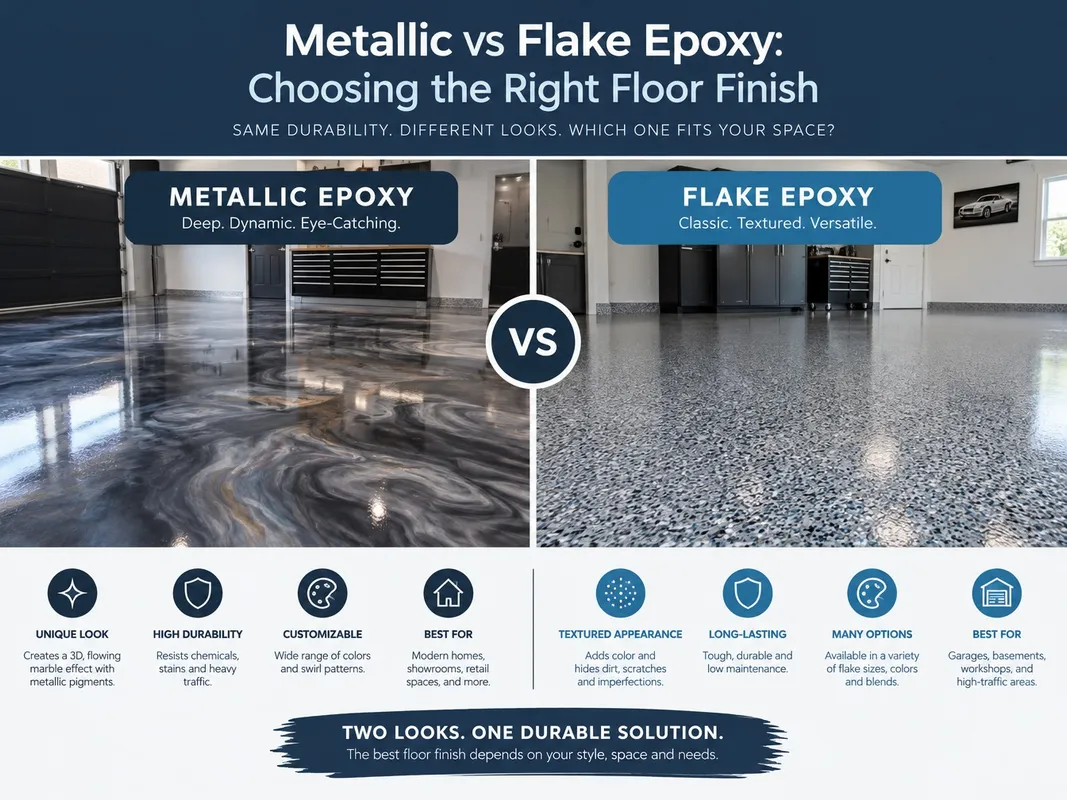
Preparing a Conroe Concrete Slab: Moisture, Cracks, and Clay Soil
Preparing a Conroe concrete slab for coating: moisture testing, clay soil movement, crack repair, and grinding. Why prep decides the outcome.
- concrete prep
- slab moisture
- conroe tx
Prep decides whether the coating lasts at all
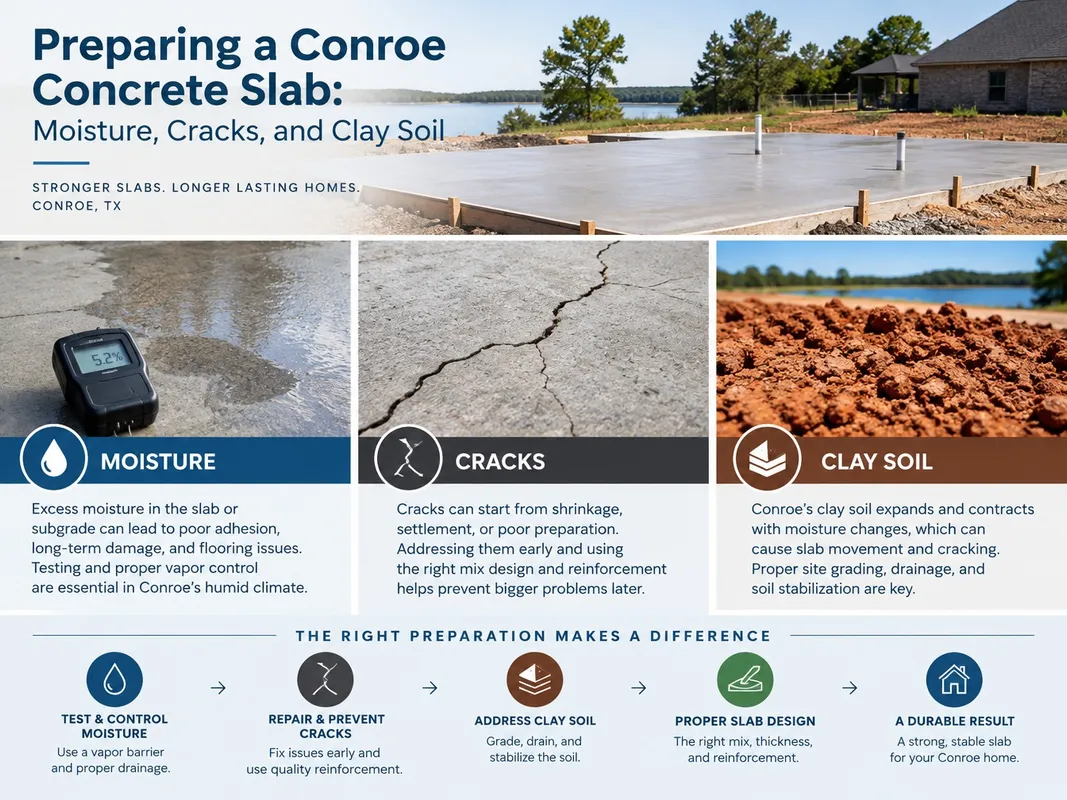
Every floor coating we install is bonded to a concrete slab, and that bond is only as good as the slab underneath. In Conroe, preparing a slab means four things: measuring moisture, understanding the clay soil below it, repairing cracks and joints, and mechanically grinding the surface. Skip any one of them and even the best resin will eventually blister, peel, or fail. The coating is the visible part. The prep is the part that does the work.
Start with moisture, not color
Before we talk about finishes, we check the slab for moisture. Concrete is porous, and a slab-on-grade garage sits directly on the ground. Without a vapor barrier under it, ground moisture migrates up through the concrete and pushes against anything applied on top. That pressure can lift a coating from below, and the result looks like a blister or a bubble even though nothing was wrong with the installation itself.
Plenty of older homes around Conroe and Montgomery County were poured before vapor barriers were standard. That means moisture testing is not an upsell, it is the first real decision in the project. If readings are low, we coat normally. If they are high, we adjust the system, usually with a moisture-mitigating primer or a base product designed to tolerate vapor. If the slab is actively wet, we tell you to address the water before spending money on a finish. You can read more about that work on our concrete prep and repair page.
How we test for moisture
There are a few standard ways to measure moisture in a slab. The simplest is a plastic-sheet test, taping a square of clear plastic to the concrete and checking for condensation underneath after a day. It gives a rough read, not a number. A calcium chloride test measures the rate of vapor transmission over a set period and produces a quantifiable result. A hand-held moisture meter gives an instant reading at the surface and is useful for checking a large floor quickly.
We use the test results to decide whether the slab needs a moisture-mitigating primer, and we do not guess at it. A floor over a slab with high readings but no vapor control is a floor on borrowed time.
Clay soil and how it moves
Montgomery County sits on expansive clay. The soil swells when it is wet and shrinks when it dries, and it does this over and over as our weather swings between downpours and long hot dry spells. That movement is what cracks driveways and slabs, and it is what creates the settling cracks we see in garages across the area.
We cannot stop the soil from moving, and no coating can. What we can do is distinguish between cracks that are stable and cracks that are still moving, then treat them accordingly. A stable crack can be filled and bridged so the coating spans it. A crack that is actively opening and closing is a sign of movement we need to understand before we coat, because a coating applied over an active crack will simply crack again in the same place.
New concrete needs time before it is coated
If the slab is a recent pour, it has to cure before we coat it. Fresh concrete holds excess moisture that has to leave, and that process takes time even in our warm climate. Coating a young slab traps that moisture under the film, and the coating tells you about it later by blistering. When a project involves new concrete, we talk timeline up front so nobody is surprised by a wait.
Cracks, control joints, and spalling
Not every crack is a problem, and not every crack is the same.
Hairline cracks are common and usually cosmetic. They get cleaned, filled, and bridged.
Settling cracks are wider and often run diagonally across a slab. These get evaluated for movement before repair.
Control joints are cut into the slab on purpose to control where it cracks. They stay as joints on a coating job unless we have a reason to fill them, and they need to be handled so they do not telegraph through the finish.
Spalling and scaling are where the surface of the concrete flakes or breaks down. Spalled areas have to be cleaned back to sound concrete and rebuilt with a repair mortar before coating, or the coating will sit on top of loose material and pop off.
Grinding versus acid etching
The mechanical bond between coating and concrete depends on the surface profile. We diamond-grind the slab, which opens the concrete and creates that profile, typically to what is called a CSP 2 to 3 finish. The coating grips an actual rough surface rather than sitting on a smooth one.
Acid etching is the shortcut. It cleans and slightly roughens the concrete, but it does not create the same profile, and it can leave residue behind that weakens the bond if it is not fully neutralized and rinsed. When we are called to fix a failed floor, an acid-etched slab under a peeling coating is one of the most common things we find. The correct sequence for the systems we install is described on our garage floor coatings page.
What we actually do during prep
The prep stage follows a set order so nothing gets skipped.
- Evaluate and measure. We inspect the slab, note cracks, joints, spalling, and any existing coating, and measure the square footage.
- Test moisture. We check the slab so we know whether a moisture-mitigating primer is needed.
- Remove old coatings. Paint, sealer, and failed epoxy are ground off so the new system bonds to concrete, not to a dead layer.
- Grind the surface. Diamond grinding opens the profile across the whole floor and along the edges.
- Repair. Cracks, joints, and spalled areas are filled and leveled with the right material.
- Clean and prime. The floor is vacuumed clean, and primer goes down where the slab calls for it.
Only after that does the decorative coating begin. Homeowners sometimes ask why we cannot “just coat it,” and the honest answer is that the prep is most of what they are paying for.
Drainage around the slab
Prep is not only about the top of the concrete. Water management around the garage matters just as much. If the yard or driveway slopes toward the garage, or a downspout dumps next to the wall, water sits against the slab and feeds the moisture problem from the outside. Regrading, extending a downspout, or fixing a low spot along the driveway can do more for a floor’s long-term health than a more expensive coating would. We point this out on estimates because it is cheaper to fix the water than to keep fighting it. In some Conroe-area neighborhoods, the HOA also has a say in what is visible from the street, which matters if you plan to coat a driveway apron; check the covenants before you pick a color or finish.
Old coatings and contaminants
Oil, paint, sealer, and adhesive all interfere with bonding. Contaminated concrete has to be ground back to clean material. If a slab has been used as a workshop for years, we pay extra attention to the parking and work areas, where oil has had time to soak in. Grinding removes the surface, and in bad spots we may need to grind deeper or use a primer designed for the situation. The goal is always the same: the coating has to bond to concrete, not to a contaminant.
What happens if you skip prep
The failure modes are predictable. A slab with high moisture blisters the coating from below. A slab that was not ground peels in sheets, especially under hot tires. Cracks that were not filled telegraph through the finish within a season. Spalled areas let the coating break away in patches. In each case, the floor looks fine for a while, then fails in a way that costs more to fix than proper prep would have cost up front. That is the real argument for doing it right, and it is why cheap quotes usually ignore this stage.
When we tell you not to coat
Sometimes the right answer is no. If a slab has structural movement, an active water problem, or concrete that is too far gone to hold a coating, we say so rather than take the job and let you find out later. A floor over a moving or wet slab will not stay put, and we would rather tell you what the slab needs than sell you a finish that fails. You can read more about how we work about our approach.
Building on a solid foundation
A floor coating is a thin layer on top of a big piece of concrete, and the concrete always wins. Test the moisture, understand the clay, repair what is broken, and grind the surface. Do those things and the coating has a chance to last for years. Skip them, and no product will save it. If you want to see how prep fits into the full system, look at polyaspartic flooring and commercial and industrial flooring for the larger-scale version of the same process.
Curious where your slab stands? Read why Texas heat ruins cheap garage floors for the failure side of the story, or see what epoxy flooring costs in Conroe to plan the investment.
Ready for an honest look at your concrete? Request a free estimate or call Conroe Epoxy at (346) 220-3416, and we will test the slab before we quote it.