Epoxy vs Polyaspartic Flooring: Which Is Right for Your Conroe Garage?
Epoxy vs polyaspartic garage floors in Conroe, TX: cure times, UV stability, hot-tire resistance, and cost, explained by local installers.
- epoxy flooring conroe
- polyaspartic
The short answer: use both, in the right order
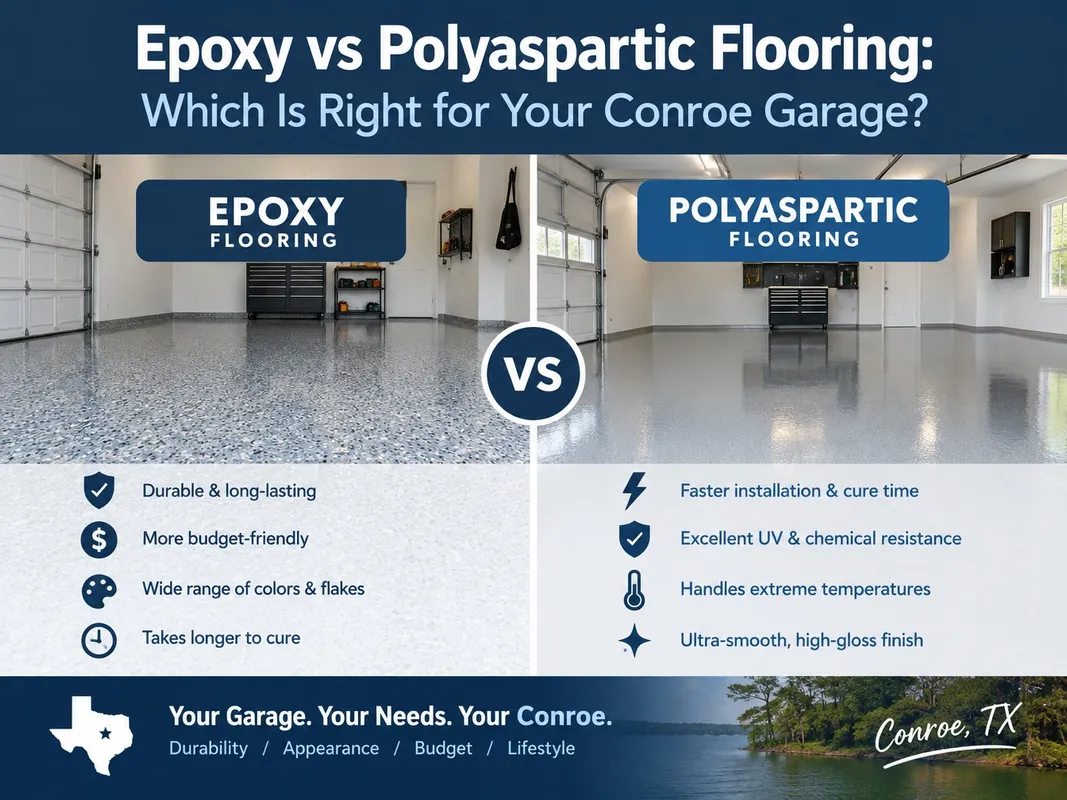
For a Conroe garage, the strongest floor is almost always a hybrid — a pigmented epoxy base coat, a full broadcast of vinyl flake, and a polyaspartic topcoat. Epoxy delivers the build, the color, and the chemical resistance. Polyaspartic delivers the fast cure, UV stability, and the abrasion and hot-tire resistance a garage slab in Southeast Texas actually needs. If you truly had to choose one resin, polyaspartic is the better all-around garage finish, but the hybrid outperforms either product on its own.
They are different chemistry, not different brands
The two words get swapped constantly, which is why quotes for the “same” floor can differ so much. They are not two brands of the same thing.
Epoxy is a two-part thermoset resin. Mix resin and hardener, and a chemical reaction cures it into a hard, dense film. It wets out concrete well, builds film thickness, and resists chemicals, oils, and stains. Standard epoxy needs roughly 12 to 24 hours between coats and generally 24 to 48 hours before you walk on it. It is a superb base coat and color coat.
Polyaspartic is a two-part aliphatic polyurea. It cures much faster, stays slightly more flexible, and — critically for us — resists UV yellowing. Used as a topcoat, it shields the color underneath from the sun and stands up to hot tires and road chemicals. It goes on thinner than epoxy, so it is usually a sealer, not the entire floor.
When you read a quote, the important question is which resin is doing which job: base, color, flake, or topcoat.
Head to head
| Feature | Epoxy | Polyaspartic |
|---|---|---|
| Cure time between coats | 12–24 hours | 2–6 hours |
| Return to foot traffic | 24–48 hours | 4–8 hours |
| Full return to service | 3–7 days | 24 hours |
| UV stability | Ambers and yellows | Stays clear |
| Hot-tire resistance as a topcoat | Moderate | High |
| Flexibility | Rigid | More flexible |
| Typical role in a garage | Base and color coat | Topcoat and sealer |
| Relative material cost | Lower | Higher |
| Full-sun exterior use | No | Yes |
A table hides nuance, but the pattern is dependable: epoxy is the foundation, polyaspartic is the armor.
What actually fails first on a garage floor
Garage coatings do not usually fail in the middle of the floor. They fail at the edges and at the garage door, where sun, water, and road salt concentrate, and under the tires where heat and weight combine. That tells you where the system has to be strongest: a UV-stable topcoat at the door, a solid bond at the perimeter, and heat resistance exactly where the car parks.
A second failure point is the flake layer. Flake is not only decorative. A full broadcast of vinyl flake adds texture for grip when the floor is wet, hides the small imperfections every slab has, and gives the topcoat something to lock around. A thin, sparse flake coat over a smooth slab looks flat and shows every scuff and tire mark.
Why the hybrid system wins in Southeast Texas
Three local conditions push us toward the hybrid.
Sun. Plenty of Conroe homes have garage doors facing west or south, and afternoon sun drives straight into the opening. A bare epoxy clear coat will amber over time; it turns a warm, yellow-brown. A polyaspartic topcoat blocks the UV that causes it, so the flake and color stay true.
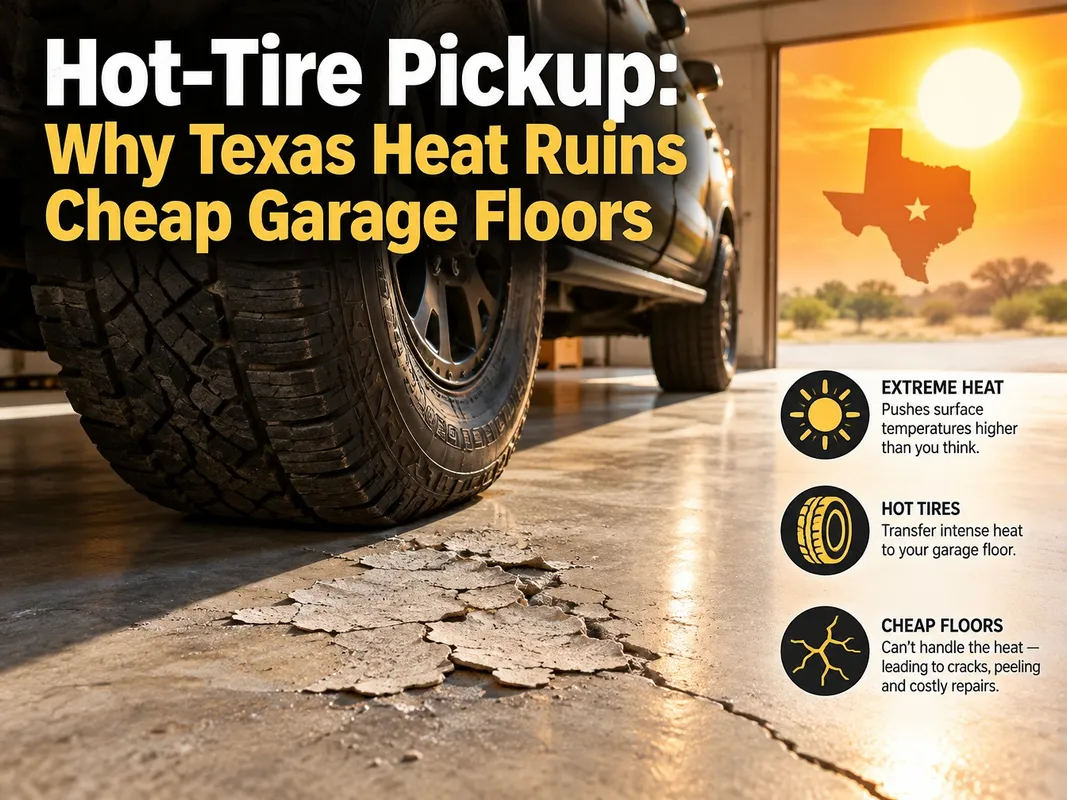
Heat. In July and August, driveway and apron surfaces sit well above the air temperature, and a tire that just came off that pavement is hot enough to soften a low-grade coating. That is hot-tire pickup: the tire grabs the floor, lifts a patch of coating, and leaves a tread imprint. A polyaspartic topcoat tolerates that heat far better. We go deeper on this in why Texas heat ruins cheap garage floors.
Humidity. The Gulf Coast keeps the air heavy most of the year. Fast-curing polyaspartic is less sensitive to humidity than a slow epoxy, so we can lay the topcoat without waiting for a perfect weather window.
The slab matters more than the resin
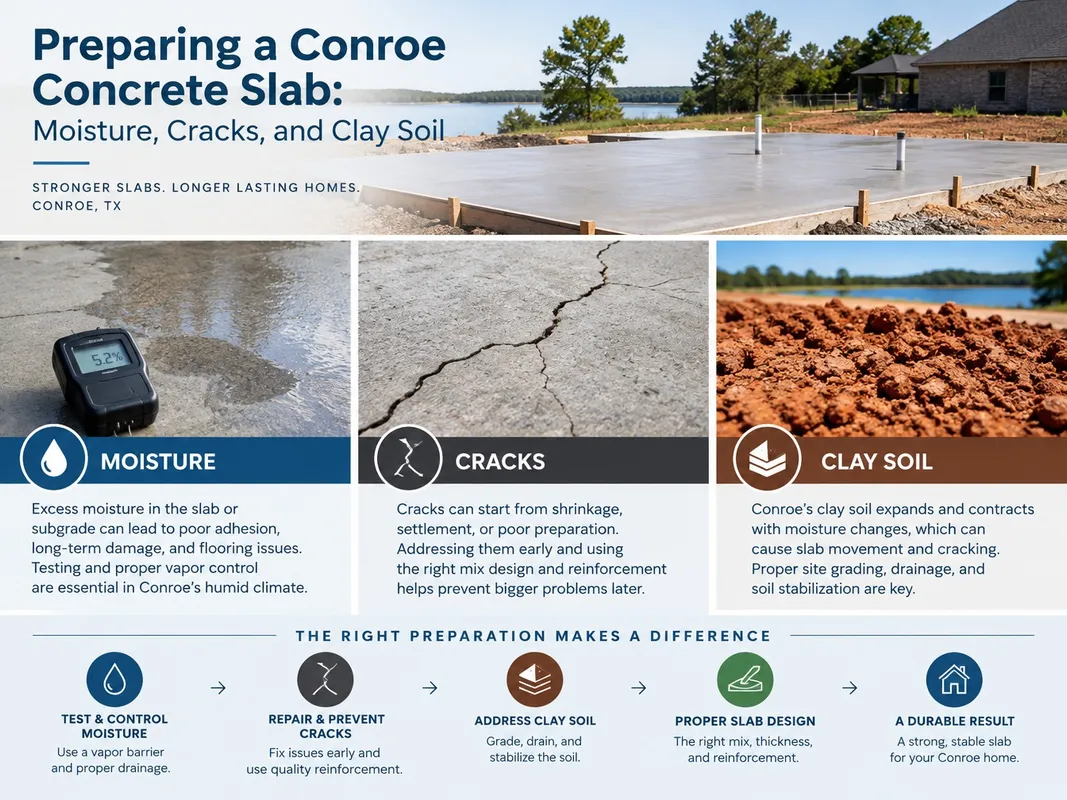
No coating survives a wet slab. Montgomery County sits on expansive clay, and many slab-on-grade garages here were poured decades ago without a vapor barrier. Concrete is porous. Without a barrier, ground moisture wicks up through the slab and pushes against anything sitting on top of it, and that vapor pressure can blister or debond a coating that was installed correctly.
That is why we test for moisture before we quote, not after. If readings are high, the plan changes: a moisture-mitigating primer, a different base, or a recommendation to address the source first. The full process is on our concrete prep and repair page.
Color, flake, and the look you are after
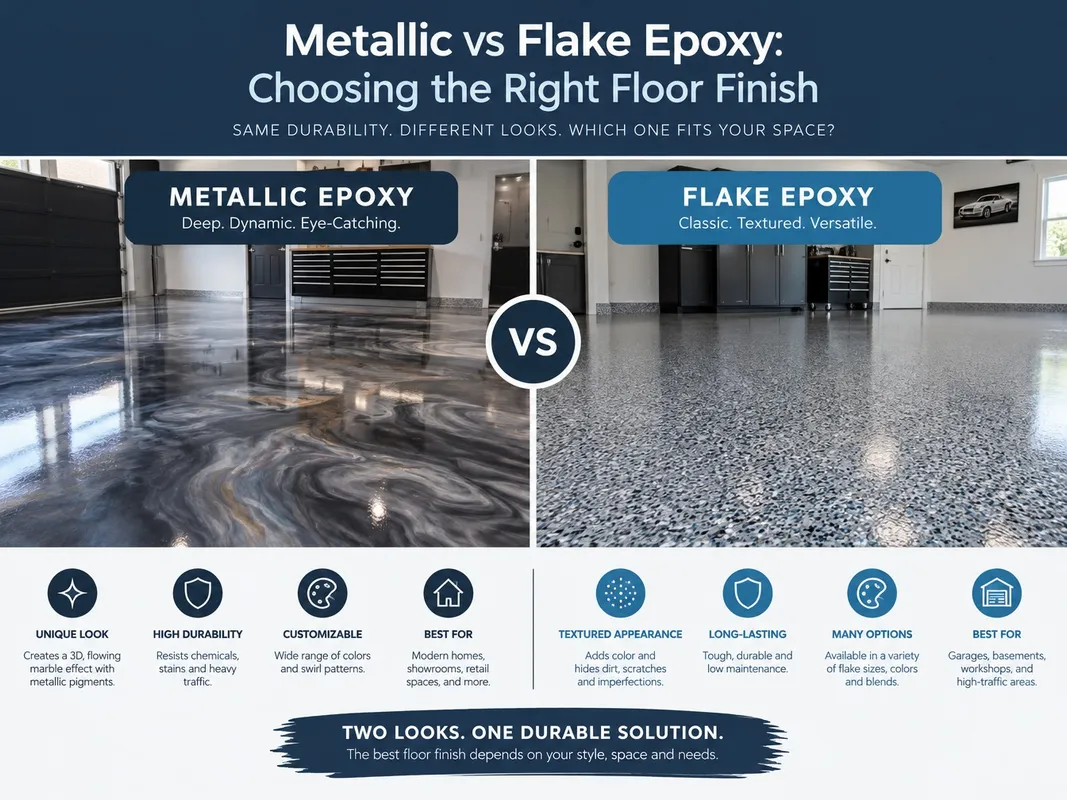
Chemically, epoxy and polyaspartic do not care what color they are. Practically, the finish is built from a base color plus the flake blend you choose, and that blend is what people actually see. Solid colors show every tire mark and scuff; a multi-color flake blend hides dust and still reads as a clean, uniform floor. If you want movement and depth rather than a speckled surface, that is a different product entirely. The standard look is covered on our flake epoxy systems page, and the dramatic one under metallic epoxy flooring.
What the two systems cost in Conroe
Pricing depends on square footage, slab condition, crack repair, moisture mitigation, flake coverage, and the number of topcoats. As rough planning ranges for a typical two-car garage (about 400 to 500 square feet):
- Basic single-color epoxy with a thin clear: roughly $4 to $6 per square foot installed.
- Hybrid epoxy base, full flake broadcast, polyaspartic topcoat: roughly $6 to $9 per square foot.
- Premium full-flake system with an added topcoat and moisture primer: the top of that range or slightly above.
These are ballpark numbers for budgeting, not quotes. A three-car garage, heavy crack repair, or a slab that needs moisture mitigation moves you toward the high end. We put a written, itemized number together after an on-site look. For a fuller breakdown of the variables, read how much epoxy flooring costs in Conroe.
When epoxy alone makes sense
Epoxy by itself is not wrong; it is just wrong as a sun-exposed topcoat. If you are coating an interior workshop, a back room, or a rental where budget matters more than longevity, a straight epoxy flake floor can be the sensible call. It still needs proper prep, and it will still wear faster than a hybrid, but it costs less up front.
When a polyaspartic-based system makes sense instead
Polyaspartic can also serve as both base and topcoat in a thinner build. That is common on outdoor patios and garage aprons under full sun, and on commercial projects where a fast return to service matters more than film thickness. If your project is exterior, see our patio and outdoor coatings or polyaspartic flooring pages.
Preparation is the real difference between lasting and peeling
Whichever chemistry you choose, the bond comes from the prep. We diamond-grind the slab to open the concrete’s surface profile, typically to a CSP 2 to 3 finish, then fill cracks and control joints before any resin goes down. Acid etching is cheaper and fails sooner because it does not create the same mechanical tooth. The full sequence is on our garage floor coatings page.
How to choose
- Sun hits the garage floor: choose a polyaspartic topcoat.
- Interior space, tight budget: a straight epoxy flake floor may be enough.
- Older or damp slab: test first, and let the coating choice follow the test.
- You want a one-of-a-kind floor: neither of these is the answer. See metallic epoxy flooring.
Get a straight answer for your slab
Every garage is a little different, and the right system depends on your concrete, your sun exposure, and how you use the space. We will look at your floor, test it, and tell you plainly what it needs, including when a cheaper system is the honest choice. Visit the services overview to see how the systems fit together, or read about our approach before you decide.
Ready to talk it through? Request a free estimate or call Conroe Epoxy at (346) 220-3416, and we will schedule an on-site walkthrough.