Polyaspartic flooring for Conroe garages and shops
Polyaspartic flooring is a two-part aliphatic resin that cures fast and stays clear. It behaves very differently from a traditional epoxy floor. Where epoxy can take days to cure and will slowly amber in sunlight, polyaspartic sets in hours and holds its color. That combination is why it has become the go-to wear layer on nearly every floor we install around Conroe.
You can use it as a stand-alone coating over prepared concrete, or as the clear topcoat locked over a decorative flake or solid-color base. Most homeowners choose the second option: a colored or flake base for the look, then polyaspartic on top for durability.
Why polyaspartic suits Conroe and Montgomery County
A concrete slab here lives in a specific set of conditions. Gulf humidity sits over it most of the year. Red clay soil shifts with wet and dry cycles and works cracks open. Summer sun pushes garage slab temperatures high enough to soften cheap coatings, and tires come in hot enough to pull them up. Polyaspartic addresses each of those problems directly.
It cures fast enough that humidity swings during the job do not wreck the finish. It resists the hot-tire pickup that ruins a low-grade epoxy clear. It stays clear under UV instead of turning yellow. And because it is a thin, tough film, it flexes with minor slab movement instead of cracking like a rigid, thick coating can.
We still do not treat polyaspartic as a fix for a bad slab. If concrete is holding moisture or a crack is actively moving, the coating will fail no matter what resin is on top. That gets corrected during prep.
Polyaspartic is also less sensitive to application timing than epoxy. On a humid Conroe morning, a slow epoxy can blush or lose clarity while it cures, which dulls the finish. A fast polyaspartic sets before the humidity can affect it, so the floor stays clear and even when the weather is not cooperating. We still watch slab temperature and dew point on every job, but the material gives us a wider working window in this climate.
Our polyaspartic install process
We follow the same sequence on every job so the coating bonds and lasts:
- On-site evaluation. We measure the area, inspect cracks, spalling, and old coatings, and test the slab for moisture before quoting.
- Diamond grinding. The concrete is ground with diamond tooling to open its profile, then edge-ground up to walls and thresholds. This is the step that decides whether a coating sticks.
- Repair. Cracks and control joints are filled, and voids are patched and feathered flat.
- Priming. A penetrating primer goes down where the slab needs it to seal and promote adhesion.
- Base coat and decoration. The epoxy or flake base is applied and, on a flake system, broadcast to refusal while wet.
- Polyaspartic topcoats. After scraping and vacuuming, we roll two polyaspartic topcoats with slip-resistant aggregate blended into the finish.
Finishes and options
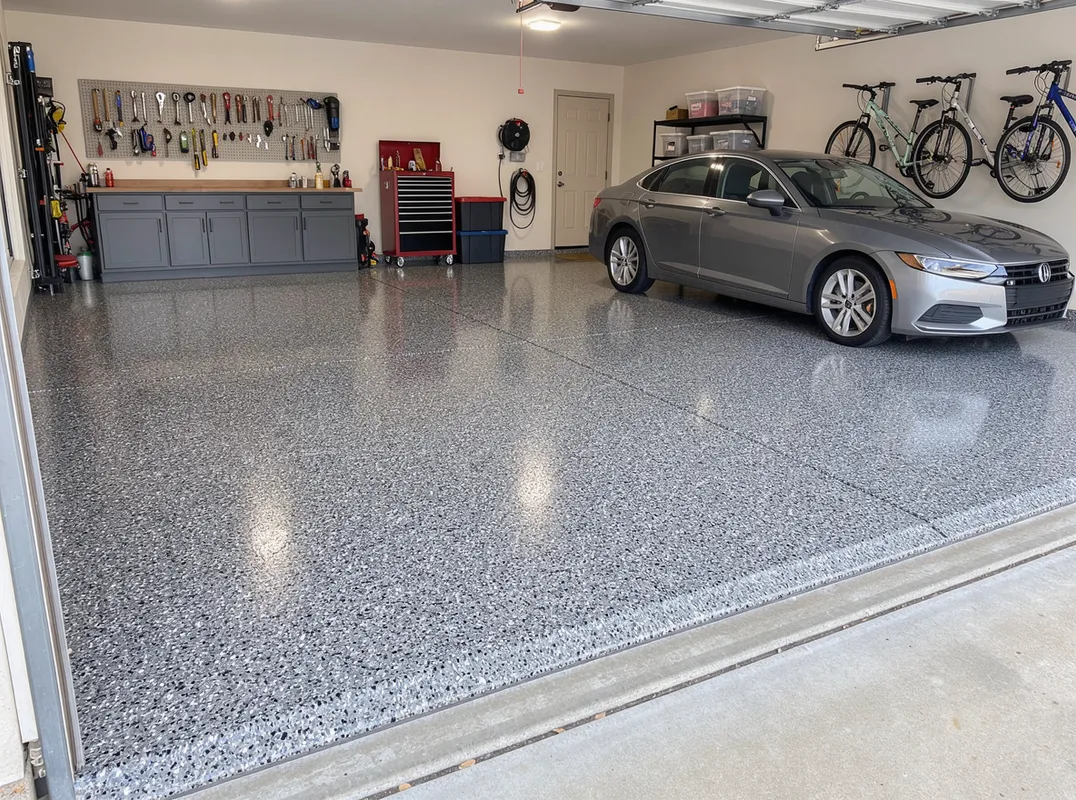
Polyaspartic is versatile because it is mostly a clear wear layer, so the look is decided underneath it. The common builds we install are a clear topcoat over a full-broadcast flake base, a clear topcoat over a solid-color epoxy, and a polyaspartic coating tinted and applied directly to prepared concrete. You can pick gloss or a lower-sheen matte, and we adjust texture from light grip for a garage to a heavier, slip-resistant profile for a shop with coolant or a steep driveway apron.
Because the clear coat takes the wear, a polyaspartic floor can be refreshed later without tearing out the whole system. When the topcoat eventually shows traffic wear, we can lightly grind it and apply a new clear over the intact base. That extends the life of the floor for a fraction of a full replacement, and it is one reason we build these floors with a serviceable top layer.
What polyaspartic flooring costs in Conroe
For a residential garage, polyaspartic systems generally land between $1,800 and $4,200. Square footage is the biggest factor, followed by slab condition, crack and moisture repair, and whether you choose a simple tinted coating or a full flake build with a decorative topcoat. Larger shops, heavy repair, and moisture-control primers move the number up.
We do not quote coatings from a phone photo. An on-site look takes about twenty minutes and gets you a written, itemized estimate.
Related services
- Need the classic flake garage look? See garage floor coatings.
- Want a custom, one-of-a-kind floor? Look at metallic epoxy flooring.
- Coating a shop or warehouse? Read about commercial and industrial flooring.
- Slab cracked or damp? Start with concrete prep and crack repair.
Ready for a number? Request a free estimate or call us at (346) 220-3416.